
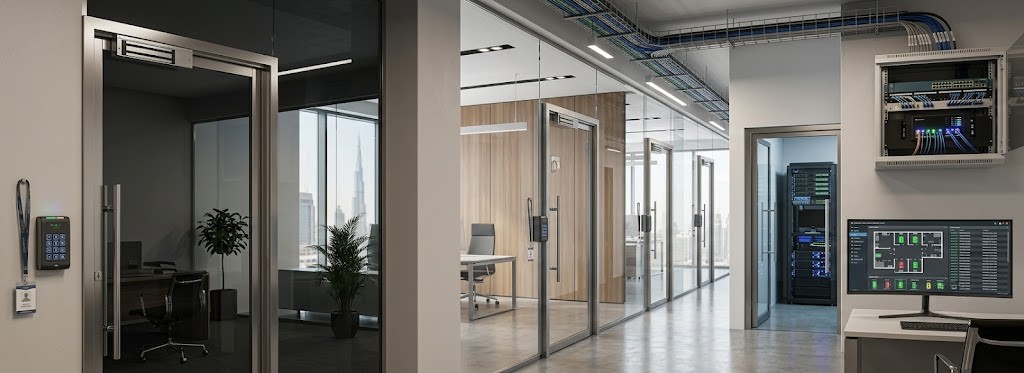
Most Dubai businesses buying access control for the first time ask the wrong question. They start with “which brand?” when the first question should be: “which architecture?”
Get the architecture wrong — standalone when you needed networked, or networked when a simpler standalone setup would have done the job — and you spend the next three years either fighting system limitations or paying for complexity you never needed.
This guide cuts straight to it. What’s the actual difference between standalone and network-based access control, what does each cost to run in a UAE business environment, and which one fits your Dubai office in 2026?
Quick Answer
Standalone access control systems manage each door independently — no central server, no network connection required. They work well for single-door or small two-to-three door setups where simplicity and low cost matter more than central management. Network-based (IP) access control connects all doors to a central controller and software platform, enabling real-time monitoring, remote management, audit logs, and scalability across multiple sites. For most Dubai offices with five or more staff and growth plans, network-based is the right long-term choice.
What Standalone Access Control Actually Means
Standalone access control is exactly what the name suggests. Each door controller operates independently, storing its own user credentials — RFID cards, PIN codes, or basic fingerprint templates — and making its own access decisions without communicating with any other device or server.
Installation is straightforward. You mount the reader and controller, programme user credentials directly into the device (usually via a keypad or a simple configuration tool), connect the electromagnetic or electric strike lock, and you’re done. No network cable run. No server licence. No IT involvement beyond the initial setup.
The limitations become apparent quickly when your needs grow. Losing an access card means physically accessing each standalone controller to delete the credential — one by one, door by door. Adding a new staff member across five doors means programming five separate devices. There are no audit logs you can pull remotely, no real-time alerts, and no way to lock down all entry points simultaneously from a management console.
For a single server room door in a small Bur Dubai office, that’s completely fine. For a 50-person company with a main entrance, server room, accounts office, and storeroom — standalone becomes a daily management problem.
What Network-Based Access Control Actually Means
Network-based access control connects every door controller to a central management platform via your LAN or dedicated security network. All credential management, access scheduling, audit logging, and real-time monitoring happen from one interface — whether that’s ZKBioSecurity, Hikvision’s iVMS-4200, or a third-party VMS platform.
Here’s what that looks like in practice. An employee joins your company. You create their profile once in the software, assign which doors they can access and during which hours, and the system pushes those credentials to every relevant controller on the network. When they leave the company, one deletion removes their access everywhere, instantly. No manual visits to individual devices.
Every door event is logged with a timestamp and user ID. You can pull an audit trail for any door, any time period, for compliance or investigation purposes. Remote lockdown — locking all doors simultaneously from your phone or a security console — takes seconds. Integration with CCTV means an access event triggers a camera clip automatically, giving you visual confirmation of every entry.
This is the architecture that makes sense for modern UAE commercial environments — offices in Business Bay, medical centres in Healthcare City, logistics facilities in DIFC or Al Quoz — anywhere that manages more than a handful of doors or more than 20 staff.
Side-by-Side Comparison
| Factor | Standalone | Network-Based |
| Setup complexity | Low | Moderate |
| Cost per door (hardware) | Lower | Higher |
| Central management | No | Yes |
| Remote access | No | Yes |
| Real-time monitoring | No | Yes |
| Audit trail / access logs | Limited (local only) | Full, centralised |
| Card cancellation | Manual, per device | Instant, system-wide |
| Multi-door management | Difficult | Native |
| CCTV integration | No | Yes |
| Scalability | Poor | Excellent |
| IT infrastructure needed | Minimal | Network + server/cloud |
| Best for | 1–3 doors, small premises | 4+ doors, growing businesses |
The Real Cost Difference — Not Just Hardware
This is where the conversation usually goes sideways. Businesses focus on per-device hardware cost and conclude standalone is cheaper. Sometimes that’s true. Often it isn’t, once you factor in the full picture.
A basic standalone access controller with RFID reader runs AED 300–800 installed per door in the UAE, depending on lock type and reader specification. A network-based door controller — Hikvision DS-K2601 or ZKTeco inBio series — runs AED 800–1,800 per door installed, plus software and network infrastructure.
That gap looks significant until you add:
- Management time — every credential change on a standalone system requires a physical visit to the device. For a 20-person office with monthly joiners and leavers, that’s real hours spent by someone with a laptop and a programming cable.
- Incident response — a lost card on a standalone system stays active until someone manually programmes its deletion. On a network system, deletion is instant and logged.
- Audit requirements — UAE free zone authorities, ISO-certified businesses, and healthcare regulators increasingly ask for access logs during audits. Standalone systems cannot produce them.
- Scalability cost — adding a fourth or fifth door to a standalone setup doesn’t create a network; it creates four or five separate management problems. On a networked system, the marginal cost of adding a door is hardware only.
Honestly, for anything beyond three doors, the total cost of ownership calculation almost always favours network-based over a three-year period. The upfront difference rarely survives contact with reality.
Which Dubai Businesses Should Choose Standalone
Standalone has a genuine use case. It’s not the wrong choice — it’s the right choice for specific situations.
Small retail units or kiosks in malls or commercial strips — one server room or back-office door, low staff count, no compliance audit requirement. Standalone does the job without unnecessary complexity.
Temporary or project-based sites — construction site offices, pop-up retail, exhibition spaces — where the installation will be removed or reconfigured within 12 months. Network infrastructure investment doesn’t make sense here.
Budget-constrained single-premises SMEs where the entire security requirement is one main door and owner-managed access. If the owner programmes the system themselves and turnover is low, standalone is perfectly adequate.
Secondary internal doors on otherwise networked sites — a low-traffic storage room on a floor that isn’t cabled — where running a network drop isn’t cost-effective and the door doesn’t carry compliance or audit requirements.
Which Dubai Businesses Should Choose Network-Based
For most commercial tenants in Dubai’s office market in 2026, network-based is the correct architecture from day one — even if you’re starting with just three or four doors.
Growing SMEs — if you’re at 15 staff today and expect 40 within two years, standalone will be replaced entirely. Network-based scales without ripping out hardware.
Co-working spaces and serviced offices — member onboarding and offboarding is daily. Remote credential management isn’t optional.
Healthcare and medical facilities — HAAD and DHA compliance requirements include access logs for drug storage areas, patient records rooms, and clinical spaces. Standalone cannot produce these.
Free zone businesses — JAFZA, DIFC, DAFZA, and DMCC tenants regularly face security audits that require documented access records. Network-based systems produce audit-ready logs automatically.
Multi-floor or multi-building tenants — managing access across two floors or two offices from one console is only possible with networked architecture.
Businesses with CCTV — if you’re already running Hikvision or Dahua cameras, integrating network-based access control from the same ecosystem creates a unified security platform at no additional software cost.
Cloud vs On-Premise Network Access Control — One More Decision
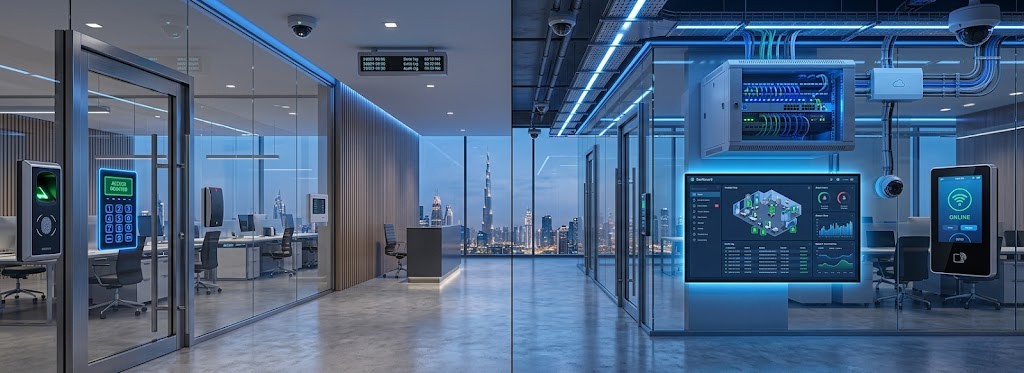
Once you’ve decided on network-based, there’s a secondary choice: on-premise server or cloud-managed platform.
On-premise — a local server running ZKBioSecurity or iVMS-4200 — gives you full data control, no monthly subscription, and performance that doesn’t depend on internet connectivity. The tradeoff is server hardware cost (AED 3,000–8,000 for a capable local server), IT maintenance responsibility, and the need for VPN setup if you want remote access.
Cloud-managed platforms — Hik-Connect, ZKTeco’s cloud offering — eliminate the server hardware requirement and make remote management available from day one without VPN configuration. Monthly or annual licensing applies. For businesses without dedicated IT staff, cloud management reduces operational burden significantly.
Most Proswift clients in 2026 are choosing cloud-managed networked systems for new installations under 20 doors, and on-premise for larger or compliance-sensitive deployments where data residency matters.
Proswift’s Recommendation for Dubai Offices
Start with the right question: how many doors, how many staff, and what does your business look like in three years?
One to three doors, stable headcount, no audit requirement — standalone works. Four or more doors, growth trajectory, any compliance obligation — network-based from day one, even if the upfront cost is higher.
The businesses Proswift sees regret standalone installations aren’t the ones who chose it for a single storeroom door. They’re the ones who chose it for a five-door office to save AED 4,000 upfront, then spent the next two years managing five separate devices and couldn’t produce an access log when their free zone auditor asked for one.
Proswift supplies and installs both Hikvision access control systems and ZKTeco access control systems across Dubai and the UAE — standalone and networked. Not sure which architecture fits your office? Contact the Proswift team for a no-obligation site assessment. We’ll tell you exactly what your specific setup needs — not what generates the largest invoice.
Top 10 FAQs — Standalone vs Network-Based Access Control for Dubai Offices
What is the main difference between standalone and network-based access control?
Standalone systems manage each door independently with no central software or network connection. Network-based systems connect all doors to a central platform, enabling unified management, real-time monitoring, remote access, and full audit logging from one console.
Which access control system is cheaper for a small Dubai office?
Standalone is cheaper upfront for one to three doors. For four or more doors, network-based typically has a lower total cost of ownership over three years when management time, incident response, and scalability costs are factored in.
Can I upgrade from standalone to network-based access control later?
Sometimes — if the door controllers are compatible with a networked architecture. In most cases, upgrading from standalone to networked means replacing the controllers entirely. It’s more cost-effective to install networked architecture from the start if growth is expected.
Do Dubai free zone authorities require access logs?
Many do. DIFC, JAFZA, DMCC, and DAFZA tenants are increasingly asked to produce access records during security audits. Network-based systems generate these logs automatically. Standalone systems cannot.
What network infrastructure does IP access control require?
At minimum, a structured cabling run (Cat6) from each door controller to a network switch, a server or cloud account for the management platform, and basic LAN configuration. Proswift handles full infrastructure design and installation as part of the access control project.
Can network-based access control integrate with CCTV cameras?
Yes — natively when using the same brand ecosystem. Hikvision access control integrates directly with Hikvision cameras through iVMS-4200, triggering camera clips on access events. Cross-brand integration is possible via ONVIF but with some feature limitations.
How many users can a standalone access control system handle?
Most standalone controllers support 500 to 2,000 card users, depending on the model. Network-based systems scale to tens of thousands of users across multiple sites with no practical upper limit for most commercial deployments.
Is cloud-based access control secure for UAE businesses?
Yes, when using enterprise-grade platforms from established vendors like Hikvision or ZKTeco with encrypted data transmission and role-based access. For businesses with data residency requirements — certain government-adjacent or financial sector tenants — on-premise remains preferable.
Can I manage network-based access control remotely from my phone?
Yes. Both Hik-Connect (Hikvision) and ZKTeco’s cloud platform offer mobile apps for remote door management, access log review, and real-time alerts. Remote lockdown of all doors is available from the app.
How long does access control installation take for a Dubai office?
A standalone single-door installation typically takes two to four hours. A networked five-door office installation with cabling, controller configuration, and software setup typically takes one to two days depending on building infrastructure. Proswift provides a project timeline estimate as part of the initial site assessment.