
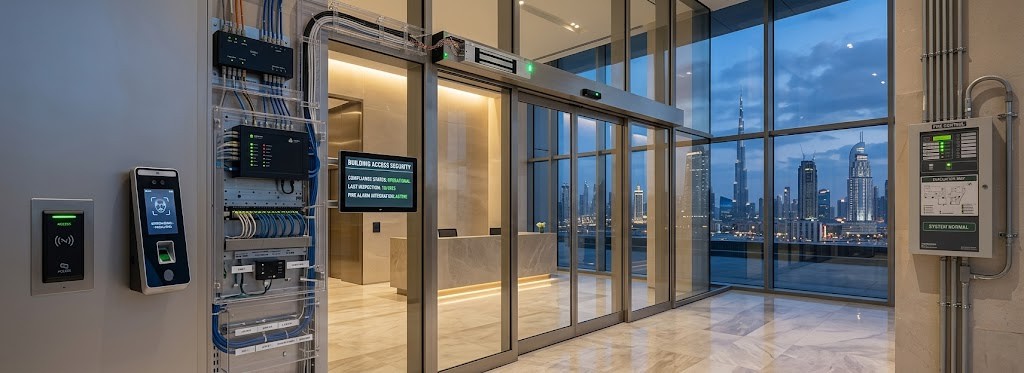
Access control installation in Dubai isn’t just a technical project. It’s a regulated one. And the businesses that discover this mid-installation — after cabling has been run, controllers mounted, and a building management team starts asking questions — end up with delays, rework costs, and occasionally, systems that can’t be commissioned until approvals catch up.
The good news is that the process is entirely manageable when you know what’s required upfront. Dubai’s regulatory framework for security system installation is well-defined. The permits exist. The approval bodies are identifiable. And an experienced installer navigates all of it as a standard part of the project — not an afterthought.
Here’s the complete picture: what permits are required, which authority governs what, how free zone buildings differ from mainland Dubai, and the installation best practices that separate a system that performs reliably for five years from one that causes problems in year two.
Quick Answer — Access Control Installation Requirements in Dubai
Installing access control in a Dubai building requires compliance with Dubai Civil Defence (DCD) regulations for fire egress and emergency exit integration, building management approval for structural modifications, and in some cases, authority approval from free zone regulators. Electrical work must comply with DEWA standards. For commercial buildings, a qualified security systems contractor with relevant trade licences is required. Permits are project-specific — the approval process starts with your installer submitting drawings and specifications before installation begins.
Who Regulates Access Control Installation in Dubai
Before permits, understand the regulatory landscape. Multiple authorities have jurisdiction over different aspects of a security system installation in Dubai — and confusing their roles is where most compliance problems start.
Dubai Civil Defence (DCD) — the primary authority for all fire and life safety systems in Dubai buildings. Access control intersects with DCD requirements at every fire exit, emergency egress door, and stairwell access point. Any door fitted with an electromagnetic lock or electronic latch must be configured to fail-safe open on fire alarm activation, integrated with the building’s fire alarm system. DCD approval is required for any installation that affects fire egress routes.
Dubai Electricity and Water Authority (DEWA) — governs all electrical installations in Dubai buildings. Access control systems require low-voltage electrical work — power supplies, cabling, lock power feeds — that must comply with DEWA regulations. In practice, this means using approved cable types, following conduit and tray installation standards, and ensuring all electrical work is carried out by a DEWA-approved contractor.
Building Management / Owners Association — commercial buildings in Dubai, particularly in Business Bay, Downtown, JLT, and DIFC, have building management teams or owners associations that govern modifications to common areas, façades, and structural elements. Drilling into concrete, surface-mounting hardware on shared walls, and running cables in common area ceiling voids all typically require building management NOC (No Objection Certificate) before work begins.
Free Zone Authorities — DIFC, JAFZA, DMCC, DAFZA, and Dubai South have their own regulatory frameworks. Security system installations within free zone premises often require authority approval separate from — and sometimes instead of — mainland Dubai permits. More on this below.
Dubai Civil Defence Requirements for Access Control
This is the area most businesses underestimate — and the one that causes the most installation complications.
DCD’s core requirement is straightforward: no electronic locking system may prevent emergency egress. In a fire or emergency situation, every door on an evacuation route must be openable — automatically and immediately — regardless of its access control state.
In practice, this means:
Fail-safe electromagnetic locks — EM locks on fire exit doors must be wired to release automatically when the fire alarm activates. This requires a direct integration between the access control power supply and the building’s fire alarm output relay. The integration must be documented and verifiable.
Request-to-exit devices — every EM-locked door must have a request-to-exit (REX) button or sensor on the secured side, allowing anyone inside to exit without an access credential. This is a life safety requirement, not optional.
Break-glass units — on designated fire escape routes, manual break-glass units that immediately cut power to EM locks are required as a secondary emergency release mechanism.
Fire alarm integration documentation — DCD inspectors reviewing a commercial building’s fire and safety systems will check that access control on fire routes is properly integrated. Missing or incorrectly wired integration is a compliance failure that can affect building occupancy certification.
The practical implication: your access control installer must coordinate with the building’s fire alarm contractor during installation. This coordination is a standard part of how Proswift manages commercial projects — not something that gets sorted out after the fact.
The Permit and Approval Process — Step by Step
Here’s the realistic sequence for a commercial access control installation in a Dubai mainland building.
Step 1 — Site survey and system design
Before any permit application, the installer conducts a site survey, maps the door schedule (which doors, what lock type, what reader specification), and prepares as-built drawings showing equipment placement, cable routes, and fire alarm integration points.
Step 2 — Building management NOC
Submit the system design drawings and a scope of work document to the building management team or owners association. This covers any structural modifications, common area cable routes, and façade penetrations. NOC turnaround varies from three days to three weeks depending on the building — factor this into your project timeline.
Step 3 — DCD review (where required)
For installations affecting fire exit doors or emergency egress routes, DCD submission is required. This typically involves submitting drawings showing lock types, fail-safe wiring, REX device placement, and fire alarm integration. DCD review timelines vary; for straightforward commercial fit-outs, two to four weeks is typical.
Step 4 — DEWA compliance for electrical work
Low-voltage electrical work for access control doesn’t require a separate DEWA permit in most cases but must be carried out by a contractor holding a valid DEWA-approved electrical contractor licence. Verify your installer holds this accreditation — it matters for building insurance and occupancy compliance.
Step 5 — Installation
With approvals in place, physical installation proceeds: cabling, controller mounting, lock installation, reader placement, power supply configuration, and software commissioning.
Step 6 — Testing and handover
Full system test including fire alarm integration verification, fail-safe testing of all EM-locked doors, and user enrolment. Documentation package provided for building management records and future DCD inspections.
Free Zone Buildings — How the Process Differs
Installing access control in a DIFC, JAFZA, DMCC, or DAFZA premises follows a different approval path — and treating it the same as a mainland Dubai project is a common mistake.
DIFC — operates under its own regulatory framework. Security system installations require DIFC Authority approval. The DIFC has detailed built environment regulations covering electrical standards, fire systems, and building modifications. Contractors working in DIFC must hold DIFC-approved contractor status.
JAFZA — access control installations within JAFZA warehouses and office units require JAFZA Authority NOC. Given JAFZA’s port and logistics security context, security system approvals are taken seriously and typically involve a security assessment component.
DMCC — JLT building installations require DMCC approval for modifications. The DMCC has a contractor registration requirement; unlicensed contractors working in DMCC premises face penalties.
Dubai South / DWC — installations in Dubai South premises, including Expo City areas, require Dubai South Authority approval with specific security standards for aviation-adjacent zones.
The practical advice: confirm your installer’s free zone approval status before engagement. A contractor approved for mainland Dubai work is not automatically approved to work in free zone premises. Proswift holds contractor approvals across major Dubai free zones — this is worth verifying with any installer you’re considering.
Cable and Infrastructure Best Practices for Dubai Buildings
Technical compliance is one dimension. Installation quality is another — and it determines whether your system is still performing reliably in year four or generating service calls from month six.
Cable specification — access control cabling in UAE commercial buildings should use shielded twisted pair (STP) for data lines and appropriate gauge stranded copper for lock power feeds. In Dubai’s temperature environment — cable tray temperatures in non-air-conditioned ceiling voids can exceed 60°C in summer — cable ratings matter. Use cables rated for the actual operating environment, not just the lowest compliant specification.
Conduit and containment — surface-run cables in commercial environments must be contained in conduit or cable trunking. This is both a DCD requirement for fire-rated areas and a building management standard for aesthetics. Plan containment routes before cabling begins — retrofitting containment after freehanging cables are run is expensive and disruptive.
Power supply sizing — a common installation error is undersizing the access control power supply. Calculate the full load: controllers, readers, and EM locks under simultaneous operation. Add 25% headroom. Undersized power supplies are the single most common cause of intermittent access control failures in the UAE, particularly during peak summer when building electrical loads are highest.
Earthing and surge protection — UAE building earthing standards vary. Access control panels and EM lock power supplies should include surge protection, particularly in older buildings or those in areas with variable power quality. Lightning surge events are not uncommon in Dubai during summer storm periods and can permanently damage unprotected controllers.
Cable labelling and documentation — every cable run should be labelled at both ends, consistent with the as-built drawings. This is non-negotiable for any building that will have ongoing maintenance. An unlabelled cable installation becomes unmanageable the first time a fault needs to be traced.
Common Installation Mistakes That Create Long-Term Problems
These are the patterns Proswift encounters when taking over maintenance of systems installed by less experienced contractors.
Skipping fire alarm integration — the most serious compliance failure. EM locks on fire exit doors wired without fire alarm integration are a DCD violation and a genuine life safety risk. This gets missed when access control and fire alarm contractors don’t coordinate.
Using indoor-rated cables in ceiling voids — standard Cat5e rated to 60°C fails in UAE summer ceiling environments. Cables degrade, insulation cracks, and intermittent faults develop that are extremely difficult to diagnose and repair.
No REX devices on EM-locked doors — every EM-locked door needs a request-to-exit sensor or button on the secured side. Missing REX devices create situations where people are trapped and are a DCD compliance failure.
Controller placement without access — mounting network controllers inside false ceilings or behind walls without an accessible junction box for future maintenance. When the controller needs a firmware update or fault investigation, the maintenance engineer faces a two-hour ceiling tile removal exercise.
Insufficient IP addressing planning — network-based access control requires static IP addresses for all controllers. Installations done without coordinating with the building IT team — using DHCP addresses that change, or conflicting with existing network ranges — cause management platform connectivity failures.
Proswift’s Approach to Access Control Installation in Dubai
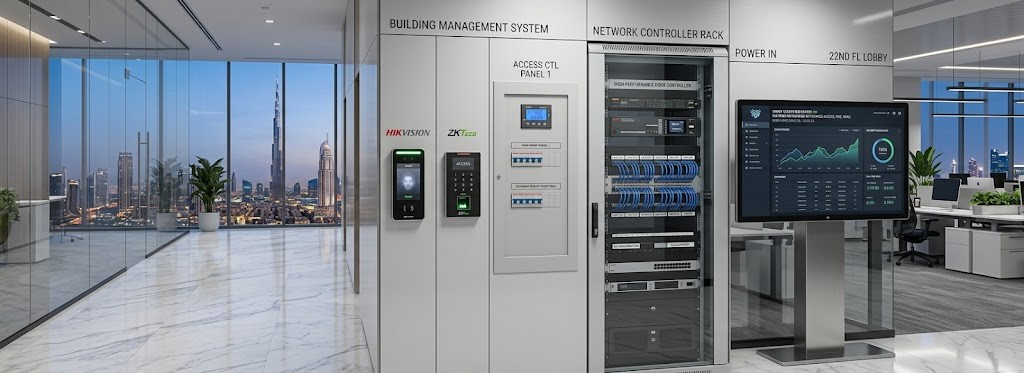
Proswift manages the full permit and compliance process as part of every commercial access control installation — survey, drawings, building management NOC, DCD coordination where required, DEWA-compliant electrical work, free zone approvals, installation, testing, and handover documentation.
Every installation includes fire alarm integration verification, fail-safe testing on all EM-locked doors, and a complete as-built drawing package for building records and future MOHRE or DCD inspections.
We supply and install Hikvision access control systems and ZKTeco access control systems across Dubai mainland and major free zones. Ongoing maintenance is covered under Proswift IT AMC contracts, ensuring your system stays compliant, maintained, and audit-ready year-round.
Contact Proswift to discuss your access control installation project — we’ll assess your site, identify the approval requirements specific to your building, and give you a clear project timeline before work begins.
Top 10 FAQs — Access Control Installation in Dubai Buildings
Do I need a permit to install access control in my Dubai office?
It depends on the scope. Installations affecting fire exit doors or emergency egress routes require Dubai Civil Defence review. Structural modifications and common area cable routes require building management NOC. Electrical work must be carried out by a DEWA-approved contractor. Your installer should identify the specific approvals required during the site survey stage.
How long does access control permit approval take in Dubai?
Building management NOC typically takes three to ten business days for straightforward commercial fit-outs. Dubai Civil Defence review for fire-route installations typically takes two to four weeks. Free zone authority approvals vary by authority — DIFC and JAFZA can take one to three weeks. Factor all approval timelines into your project schedule before booking installation dates.
What type of lock is required on fire exit doors in Dubai?
Fire exit doors in Dubai buildings require fail-safe electromagnetic locks — wired to release automatically on fire alarm activation. Electric strike locks may also be used depending on door type and fire rating requirements. All fire exit locking must comply with Dubai Civil Defence life safety standards and be integrated with the building fire alarm system.
Can I install access control myself in a Dubai building?
For low-voltage, non-fire-route installations in a private unit, basic self-installation is technically possible. In practice, commercial buildings require contractor liability insurance, DEWA-approved electrical work, and building management approval for any cabling in common areas. For any fire-route door, DCD compliance requires professional installation and documentation.
What happens if access control is installed without required permits in Dubai?
Non-compliant installations can result in building management requiring removal at the tenant’s cost, DCD compliance findings during building inspections, insurance policy complications in the event of an incident, and — in the case of fire egress violations — personal liability for building managers and business owners.
Do free zone buildings in Dubai need separate access control permits?
Yes. DIFC, JAFZA, DMCC, DAFZA, and Dubai South have their own approval processes separate from Dubai mainland permits. Contractors must hold free zone-specific approvals to work in these premises. Confirm your installer’s free zone contractor status before engagement.
How is access control integrated with fire alarm systems in Dubai?
Access control power supplies for EM-locked doors are connected to a normally-closed relay output on the fire alarm panel. When the fire alarm activates, the relay opens, cutting power to the EM locks and releasing all secured doors. This integration must be tested and documented as part of the installation handover.
What cable type should be used for access control in UAE buildings?
Shielded twisted pair (STP) cable for data lines, rated for the operating temperature of the installation environment. In UAE ceiling voids without air conditioning, cables rated to at least 75°C are recommended. Standard indoor Cat5e is insufficient for high-temperature environments and degrades over time, causing intermittent system faults.
How many access control doors can one controller manage?
This varies by controller model. Single-door controllers (Hikvision DS-K2601, ZKTeco inBio160) manage one door. Four-door controllers (Hikvision DS-K2604, ZKTeco inBio460) manage four doors from one unit. For larger installations, multiple controllers connect to a central management platform via network. Controller selection should be based on the total door schedule, not just the initial installation scope.
What documentation should I receive after access control installation in Dubai?
A complete installation should include: as-built drawings showing all equipment placement and cable routes, controller and reader configuration records, user enrolment database export, fire alarm integration test certificate, building management NOC copies, and software licence documentation. This package is essential for future maintenance, insurance purposes, and DCD or free zone authority inspections.